
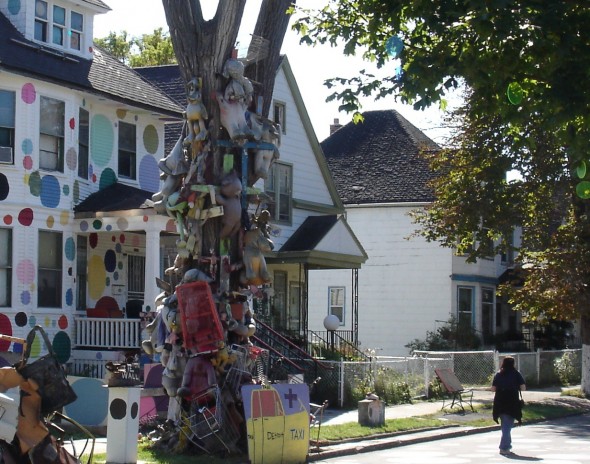
An urban conceptual art installation by Tyree Guyton called The Heidelberg Project in the former central core of Detroit, Michigan, transforms a neighborhood first devastated by the 1967 riots into a public art project. Despite a recent arson fire and the city’s ongoing financial turmoil, the public art project set amid grassy fields persists as a monument to the imagination in the face of struggle.
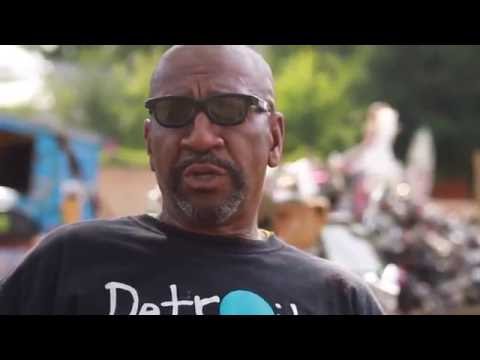
An introduction to the Heidelberg Project.
An Urban Street’s Conceptual Reboot
An urban conceptual art installation called The Heidelberg Project, named after its street location in the formerly central core of Detroit, Michigan, transforms a neighborhood first devastated by the 1967 riots, plagued by unemployment, poverty, financial redlining, racial segregation, then abandoned, burned, and largely demolished but for a few homes set among open grassy fields.
STORY: Detroit Future: Landscape Urbanism, Antidote to Industrial Blight
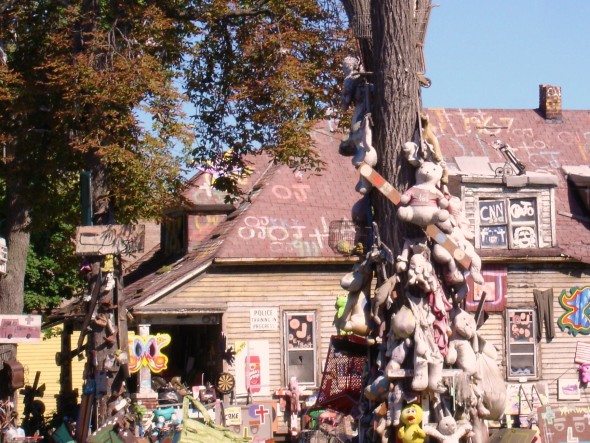
Began in 1986 by artist Tyree Guyton, with assistance from family members and friends, an arresting post-apocalyptic artistic creation rises from the ashes of urban destruction. House remnants and vacated fields are adorned with paintings, assorted articles of trashed building material sculptures, stuffed animal menageries, discarded shoe arrangements, a Hummer skeleton, among other post-industrial artifacts and urban detritus, creating a de-facto park-district-tourist-attraction. Check out the following video for an explanation from Mr. Guyton and company (video sponsored by Daimler Financial Services and produced by Suede Productions)…
STORY: Geo-Fauvism: Waking to the Wild Earth Through Visual Art
Updated 3 January 2024

Related posts:




I loved reading about and seeing this art-park-district. Planners and redevelopment agencies need to start becoming more skilled in approaching the artistic community about helping to resolve physical blight through interim, or possibly permanent, artistic installations. The social commentary function of art can be furthered, while at the same time giving a neighborhood a possible new lease on life as the curious come to be entertained and ideally stay to have a cup of coffee or lunch.
Artists are just internally compelled to mess around and express themselves, so let’s harness that energy in a positive way to shake up our thinking and inspire more mundane levels of creativity that could bring jobs and new functions to older neighborhoods.
Great article! Your style is so much better compared to most other bloggers. Thank you for posting when you do, I will be sure to subscribe!
Jack,
Excellent use of your experience in a city that is going to write the book on the rise and fall of the post industrialized mixed use urban landscape.
Pingback: Detroit’s silver lining » découverterre
Pingback: Diego Rivera and the Fall and Rise of Detroit By Jack Eidt | WilderUtopia.com
Pingback: Detroit Works: Urban Farming as Neighborhood Preservation | WilderUtopia.com
Pingback: Geo-Fauvism: Waking to the Wild Earth Through Visual Art | WilderUtopia.com
Pingback: Revitalizing Detroit One Hive At A Time with Detroit Hives
Pingback: Detroit Hives: Honey Bee Farms as Urban Revitalization
Pingback: Geo-Fauvism: Waking to the Wild Earth Through Visual Art